Before diving into reasons #2 and #3 that my family’s ministry focuses on theological education, a quick support update and some prayer requests. Next week I’ll provide a more thorough family update.
Ministry Partner Tracker
Monthly support pledged
≈ 82% of goal
We plan on departing for Lima this summer! We need to reach 100% of our monthly budget—this is required by our sending organization—in order to do move. We have to move out of our house at the end of June. After that we will be “homeless,” living with family until we are able to make the move to Peru.
Please Pray
- That we’d be able to shield our kids from some of the stress of the move so that they can enjoy precious time with friends an family.
- That we’d be able to raise the final 18% of our monthly budget soon.
- That God would give us wisdom and patience in this time of transition.
In this mini-series of blogs, I’m arguing that the church in the west has a particular opportunity and responsibility to prioritize theological education in missions. I started by answering the question “what is theological education?” Then I gave the first of ten reasons that TE is important and will be the focus of my family’s ministry:
Reason #1: Jesus tells his followers to teach new disciples all that he commanded.
Below I share the the next two reasons.
Reason #2: The NT echoes Jesus’ call to teach “the whole will of God.”
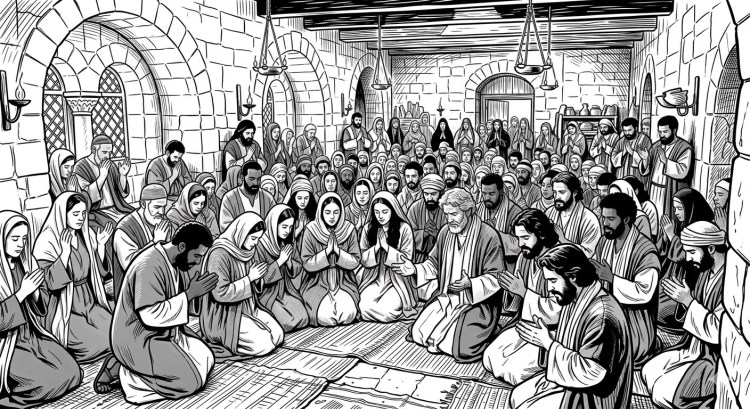
The book of Acts describes the growth of the early church. At the beginning, a group of around 120 believers—a tiny crew considering the types of crowds Jesus used to gather (e.g., the feeding of the 5000 in Luke 9:10–17)—huddled together, waiting and praying (Acts 1:14–15).
By the end of Acts, the Holy Spirit had captured the hearts and transformed the lives of thousands upon thousands in cities all over the known world. The good news of God’s work in Jesus had travelled from Jerusalem to Rome, the capital of the empire with seemingly unstoppable power. And from Rome, Paul spoke of a different kingdom; he “proclaimed the kingdom of God and taught about the Lord Jesus Christ—with all boldness and without hindrance” (Acts 28:31).
The second half of Acts focuses on Paul’s ministry. Wherever he travelled, he followed a similar trajectory. He would find a Jewish synagogue or gathering place. Then he would tell the story of the whole world highlighting how God’s action climaxes in the person of Jesus who brings salvation (Acts 13:13–41; 17:1–4; see also 17:22–31). Then he would stick around to share the good news with more people and to teach the ways of Jesus (Acts 14:21–22; 17:10–12; 18:4, 11). Sometimes he would only stay for a short period, often because people would be so angry at the implications of his teaching that they would drive him out of town. In other places, like Corinth (1.5 years; Acts 18:11) and Ephesus (3 years; Acts 20:31), he taught for extended periods of time.
Paul was not content to give a gospel presentation and move on. Rather, following Jesus’ example, he taught “the whole will of God,” as he says to the Ephesian elders (Acts 20:27). And his teaching and witness disrupted ways of life! In the name of Jesus, Paul healed people from sicknesses (Acts 14:3, 8–10). Local economies changed drastically (e.g., Acts 16:16–21) and people spent money differently (Acts 19:17–27). He addressed sexuality (1 Cor 6:12–20), discrimination (Gal 2:11–21; Eph 2), relational strife (Phil 4:2–3), pride and humility (Phil 2:1–11), wisdom (1 Cor 1:18–2:16; 8:1–13; Col 2:16–23), love (Rom 12:9; 1 Cor 13), sin (Rom 3:9–10) generosity (Rom 12:13; 2 Cor 9:6–15), the Lord’s Supper (1 Cor 12:17–34), blessings in Christ (Eph 1:3–14) and much, much more.
This same emphasis on teaching recurs throughout the NT. It becomes clear that for the early church, leaders had an important responsibility to teach and to contend for the truth to help the church remain faithful to Jesus. The frequent commands to this end assume that it will not be easy. A few examples demonstrate this:
- Paul tells Titus that he left him in Crete so that he could appoint elders. These individuals must be of high character. They must also “hold firmly to the trustworthy message as it has been taught, so that he can encourage others by sound doctrine and refute those who oppose it” (Tit 1:9). See also 1 Tim 1:3–7.
- Jude encourages believers to “contend for the faith that was once for all entrusted to god’s holy people” (Jude 1:3). In so doing, they must resist people who at best misunderstand and at worse pervert God’s grace.
- Peter writes to “remind you of these things, even though you know them and are firmly established in the truth you now have” (2 Pet 1:12). Once again, teaching helps keep God’s people firmly rooted in Jesus’ teaching and equips them to resist “destructive heresies” and “fabricated stories” (2 Pet 2). See also 1 Tim 6:3–5; 2 Tim 14–3:9; 2 John.
Of course, all this builds on a host of OT passages that call the people of God to remember what God had done and to pass on his teaching. Perhaps the most famous example comes in Deut 6:4–9:
4 Hear, O Israel: The Lord our God, the Lord is one. 5 Love the Lord your God with all your heart and with all your soul and with all your strength. 6 These commandments that I give you today are to be on your hearts. 7 Impress them on your children. Talk about them when you sit at home and when you walk along the road, when you lie down and when you get up. 8 Tie them as symbols on your hands and bind them on your foreheads. 9 Write them on the doorframes of your houses and on your gates.
And the early church did just this! So…
Reason #3: The early church devoted itself to the apostles’ teaching (Acts 2:42).
They yearned to learn the ways of God and live according to God’s design. So, they sought instruction from Jesus’ disciples, and this instruction transformed their lives:
- They spent lots of time together, becoming brothers and sisters, praying, eating, rejoicing.
- They remembered and proclaimed Jesus’ sacrificial death by celebrating the Lord’s Supper frequently.
- They used their personal possessions to care for the needs of other Christians. That is, they saw their things not as their own!
And through this small group of people who sought to live according to the teaching of the apostles who taught what Jesus commanded, the kingdom of God became visible.
So, why theological education?
Well, not only did the risen Jesus Christ tell his disciples to pass on his teaching, but the rest of the NT echoes this and the apostles’ teaching became the foundation of the early church (Eph 2:20).
Discover more from Asi es la vida...
Subscribe to get the latest posts sent to your email.
